Parameter by Nekogames is essentially an interactive design document. It could be for an RPG, or for a fighting game, or for some kind of simulation. Whatever the missing skin, it matters not. After this game, I want to play all the design documents.
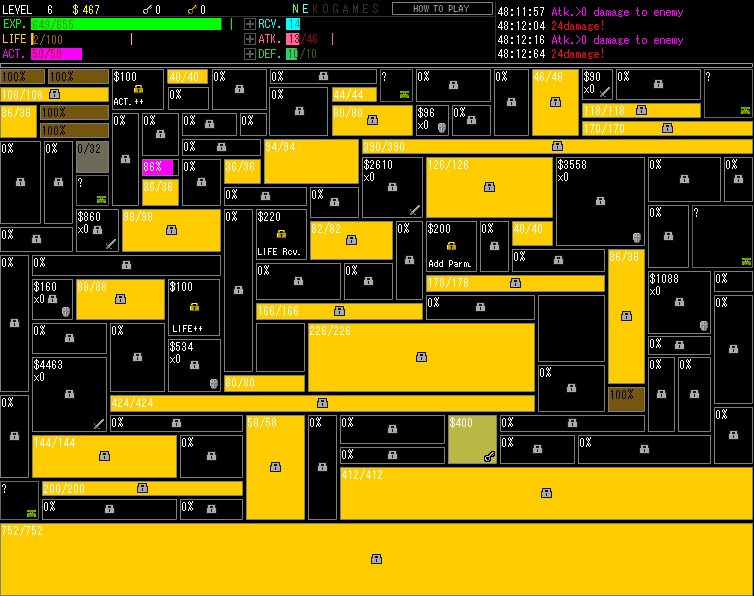
I am presented with an off-kilter spreadsheet with wonky swaths of yellow in the drunken black and grey grid. I can click on boxes. Only a few at first. Only the few which aren’t marked with the grey padlock. The boxes fill up like the status bar in a loading window. Percentages tick up. Other numbers fly out! Pink ones! Green ones! With a swipe of the cursor they are collected, even though I haven’t figured out what I’m collecting them for. How is this sea of numbers and garish yellow over abyssal black so compelling?
The top of the screen is a maze of different statistics, all described by abbreviations not always clear. An ACT. meter governs how many times you can click in a row before the message “Run>Attempted:Lack of ACT.” is displayed. A stat I can put points into called RCV. puzzled me for about twenty minutes of play until I figured out it corresponded to life recovery rate. I diagnose this not as an intentional attempt at obscurity, but rather as the inevitable result of a Japanese flash game translated without a translation budget.
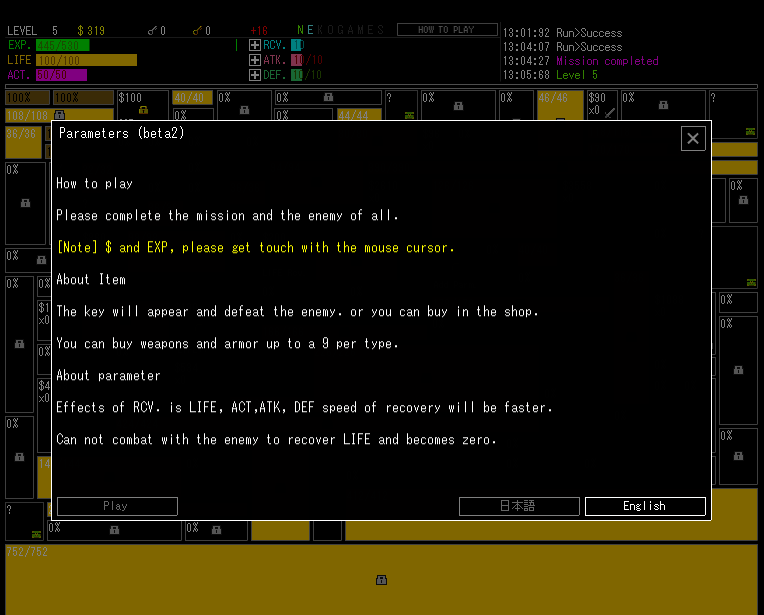
I fight yellow enemies by clicking frenetically until “You win!” is displayed across the top and the enemy box is converted into a lifeless grey, spewing out its numberly innards. There is no blood, there is no death rattle, there is no acknowledgement at all of what the entity I have defeated is, but it is gone. With my new money and EXP. I make my parameters grow stronger. The help menu lets me know that “Effects of RCV. is LIFE, ACT,ATK, DEF speed of recovery will be faster.” Thank you Nekogames. Mysterious telephone boxes explained only by a question mark are taunting me with additional unexplained mechanics. Maybe if I find the secrets of the telephones I will grow stronger... (the answer is yes. Telephones are good)
The funny thing about this playable design document is that it’s totally broken. There are serious balance issues no matter how you go about optimizing your character, resulting in a long and tedious grind (click) towards the end so as to be powerful enough to beat the final boss (represented solely as the fraction “752/752”). This is followed by a series of “greater challenges”--which are really just more excuses to make a clickclickclickclickclick noise with your mouse--ending with the kind of gleeful goodbye message of a company which is incredibly proud to have offered an experience for a player to have enjoyed. I like their attitude. That made it fun. The simplicity made it fun. And that there is no skin to this spreadsheet allowed me to assign details entirely according to my imagination. I saw it as a hacking simulator, because my imagination is dull--but it could have easily been seen as a sports management simulator, a knight simulator, even a reductionist recreation of a Counter-Strike match.
I think Parameter is more than just a broken spreadsheet rpg; it is raw enthusiasm minus the flavour text. It can be found here, and is worth experiencing--if not to the bitter end--just to get to know the numbers behind a video game a little bit better.
My rating:
I could...
A. Can not combat with the enemy to recover LIFE and becomes zero
B. Take it.
C. Leave it.
PS. (why didn’t I write about the sound in this game?)
They forgot to put sound in this game. I would really like to know what kind of music Nekogames would assign to this game. That being said, it’s probably so versatile as a reductionist piece of design because there are no textures. A score might imply an atmosphere, and an atmosphere would destroy its whole aesthetic as skeleton. I listened to the Blade Runner soundtrack when I was playing. I would imagine I would have had a very different experience listening to renaissance lute music while playing. Perhaps that’s worth another try.
There, now I’ve written about the sound in this game. Mission complete.